
 Dashboard
 Order now


An abstract is a short summary of your academic paper, but writing it well can still feel difficult. After spending so much time on the full paper, it is not always easy to reduce everything to one clear paragraph.
Still, this skill is important. Your abstract helps readers quickly understand what your paper is about, what you did, and what you found. It is useful for professors, researchers, and anyone deciding whether to read the full work.
In this guide, you will learn how to structure and write an abstract that presents your research accurately.
Table of contents
What Is an Abstract in a Paper?
An abstract is a concise, standalone summary of your entire research paper. Its primary function is to provide a complete overview of your study, allowing readers to quickly determine if your paper contains the specific information they need for their own work.
Typically, an abstract ranges from 150 to 250 words. It's usually placed after your title page and right before the main introduction of your document.
Students often confuse the abstract with the introduction. Below is a breakdown of how they differ.
Feature | Abstract | Introduction |
|---|---|---|
Purpose | Summarizes the entire paper, including the final results. | Introduces the topic and hooks the reader without revealing the conclusion. |
Length | Strictly limited (usually 150-250 words). | Can span multiple paragraphs or pages depending on the paper length. |
Content | Contains methods, findings, and implications. | Contains background context, literature review, and the thesis statement. |
To ensure your summary is comprehensive, you must include the following core structural elements:
Background: why the topic matters.
Problem statement: the specific gap in knowledge you are addressing.
Methodology: how you conducted the research.
Results: what you actually found.
Conclusion: what your findings mean for the broader field.
How to Write an Abstract in 5 Steps
Completing an abstract is much easier when you break the paragraph down into manageable, logical pieces. Below, we will walk through the steps on how to write an abstract for a paper.
Step 1: State Your Research Purpose and Motivation
Start your paper abstract by clearly stating the key goal of your study to give the reader immediate context. To articulate your main research question, ask yourself: What broad topic am I investigating, and why does it matter right now? Draft one sentence that introduces the general field of study and your specific focus within it.
Below we will provide some examples to illustrate the process.
Example: Research Purpose
Recent shifts in global climate patterns have accelerated the need for sustainable energy alternatives.
Step 2: Define the Core Problem You Are Solving
Once you establish the broad topic, you must immediately pinpoint the specific issue your paper addresses. Describe the gap in current knowledge by identifying what previous research has missed or what current solutions fail to achieve.
Use transition words like "However" or "Despite" to pivot smoothly from the general topic to your specific problem.
Example: Problem Statement
Despite the rapid development of renewable energy technologies, the implementation of solar grids in rural communities remains hindered by high initial infrastructure costs.
Step 3: Describe Your Research Methodology
When checking an abstract of a paper, readers need to know how you investigated the problem to trust the validity of your findings.
Summarize your study design and data collection methods in one or two sentences. Specify whether your approach was qualitative, quantitative, or mixed-methods. Then, explicitly name the tools you used (e.g., surveys, case studies, or lab experiments). Avoid highly technical jargon that requires a full paragraph to explain.
Example: Methodology
To investigate these barriers, this study utilized qualitative surveys and semi-structured interviews with 50 local government officials and energy contractors across three rural districts.
Step 4: Summarize Your Key Results and Findings
Findings are the most crucial part of your abstract in a paper, as it delivers the actual outcomes of your study. Select the one or two most impactful data points or qualitative themes that directly answer your research question.
Do not list all your findings; instead, choose the primary discovery that proves your thesis.
Example: Key Findings
The analysis revealed that community-subsidized solar programs resulted in a 40% reduction in local carbon emissions and a 25% decrease in household energy expenditures over two years.
Step 5: Outline Your Conclusion and Implications
Finally, you must explain the broader impact of your study. Connect your findings back to the main problem by stating what your results mean for the field.
Ask yourself: How should these results change future research, practice, or policy? Draft one final sentence that answers this question.
Example: Conclusion
These findings suggest that targeted government subsidies for initial infrastructure costs are essential for making renewable energy accessible in rural areas, ultimately accelerating national climate goals.
Step6: List Keywords in Your Abstract
Keywords are a short list of specific terms or phrases placed directly below your abstract paragraph. They are vital for academic database searchability. When another student or researcher types these exact words into search engines like Google Scholar or JSTOR, your paper will appear in the results.
Follow these tips to choose effective keywords:
-
Choose 3 to 5 terms that accurately represent your core topic, methodology, and specific demographic.
-
Use recognized academic terminology rather than informal or colloquial phrases.
-
Avoid repeating words that already appear in your paper's main title.
-
Test your keywords by searching them in an academic database to verify that similar papers appear.
Example: Keywords
Keywords: renewable energy, rural infrastructure, solar grids, qualitative survey, climate policy.
Common Mistakes to Avoid While Writing an Abstract
Adhering to strict formatting guidelines is non-negotiable, as journals and professors will often penalize or reject papers that fail to follow standard abstract rules. Avoid these frequent errors when writing an abstract for a paper:
Including new information.
Do not introduce facts, arguments, or terms that do not appear in the main body of your paper.Writing too much.
Exceeding the standard 250-word limit often causes digital databases to cut off your text mid-sentence.Using overly complex jargon.
Do not use highly specialized acronyms without defining them, as this alienates readers outside your specific subfield.
Furthermore, citing external sources is generally prohibited here. The abstract is a summary of your original work, not a literature review. Save your citations for the introduction and discussion sections.
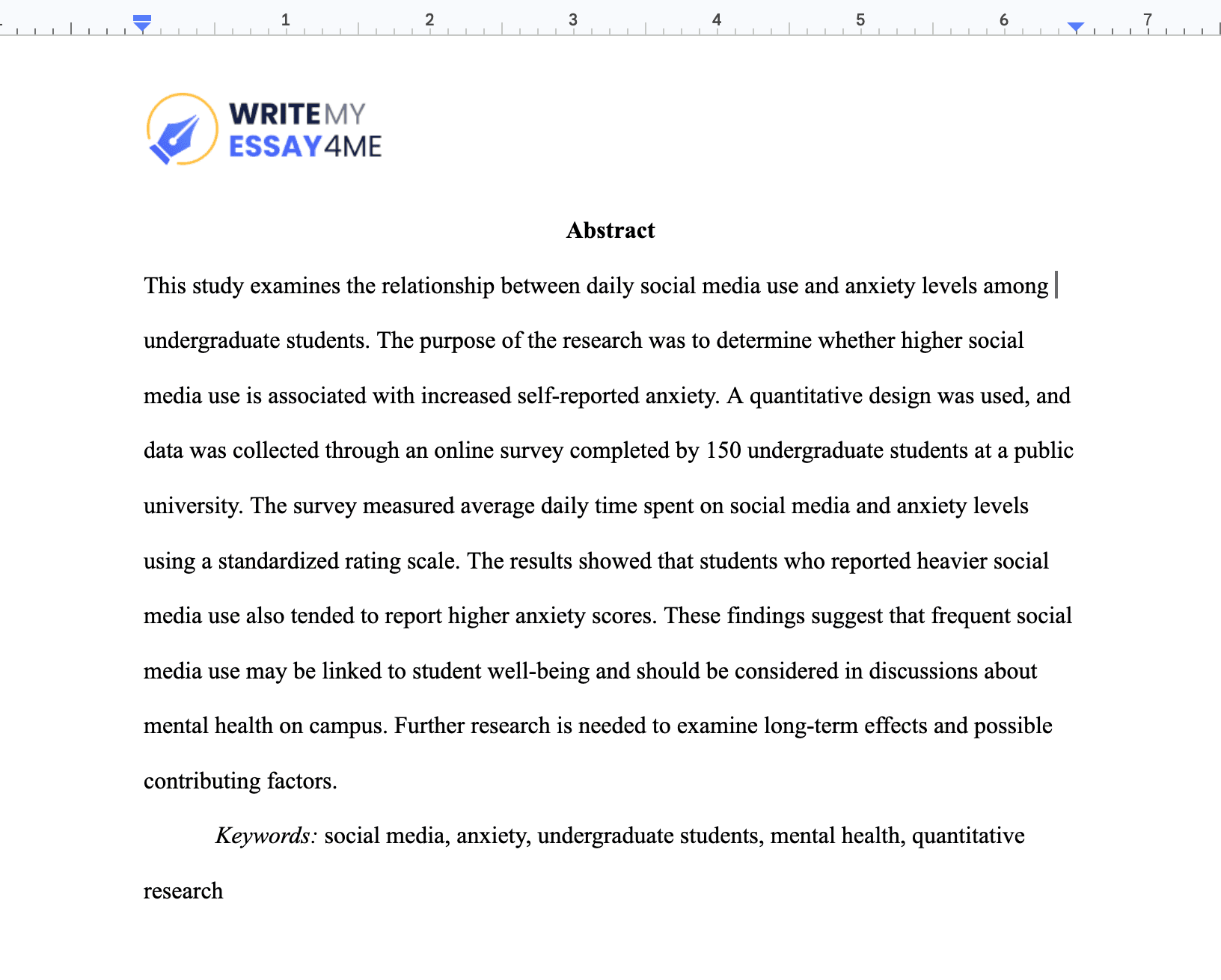
Paper Abstract Example
Below is an example of an abstract so you can see how a short summary presents the purpose, method, and main findings of a paper in one clear paragraph.
Final Thoughts on How to Write a Good Abstract
Writing an abstract is an important final step in the research process. It helps you present your study in a short and clear way, so readers can quickly understand what your paper is about.
Quick Tip
Write the abstract last. It is much easier to summarize your paper after the full draft is finished. Once the paper is complete, you can identify the main points and turn them into a clear summary.